
The UEFA Champions League has undergone a dramatic transformation for the 2024/25 season, and as a football analyst who has been tracking European competitions for over a decade, I can tell you this might be the most significant structural change we’ve seen since the tournament’s rebranding. The traditional group stage that fans have memorized for years is gone, replaced by a single league phase that promises more drama, more big matches, and a qualification system that will keep us on the edge of our seats until the very last matchday.
As someone who has covered countless Champions League nights, from the tension of knockout football to the celebrations of qualification, I’ve spent the last few weeks analyzing how this new format actually works. Let me share what I’ve discovered about the pathway to the knockout rounds, because trust me, it’s not as complicated as it first appears.
Understanding the New League Phase Structure
From Groups to a Unified Table
The most fundamental change is the elimination of the traditional eight groups of four teams. Instead, we now have a single 36-team league where every club plays against eight different opponents – four at home and four away. This means no more predictable group dynamics where familiar rivals face each other twice. The variety of opposition creates a much more authentic test of a team’s quality.
I remember speaking with football strategy consultant Michael Thornton earlier this season, who told me, “This format eliminates the ‘group of death’ concept but replaces it with a marathon that tests squad depth and tactical flexibility like never before.” He’s absolutely right – you can’t just peak for two specific matches anymore.
The Points System and Tiebreakers
The points system remains familiar: three points for a win, one for a draw, zero for a loss. However, with 36 teams in a single table, tiebreakers become crucial when multiple clubs finish on identical points. The primary tiebreakers are:
- Goal difference across all eight matches
- Total goals scored
- Away goals scored (still relevant despite removal in some competitions)
- Wins recorded
- Away wins recorded
- Disciplinary points (yellow and red cards)
- UEFA club coefficient ranking

The Points System and Tiebreakers
The Two Pathways to the Round of 16
Automatic Qualification: Top Eight Finish
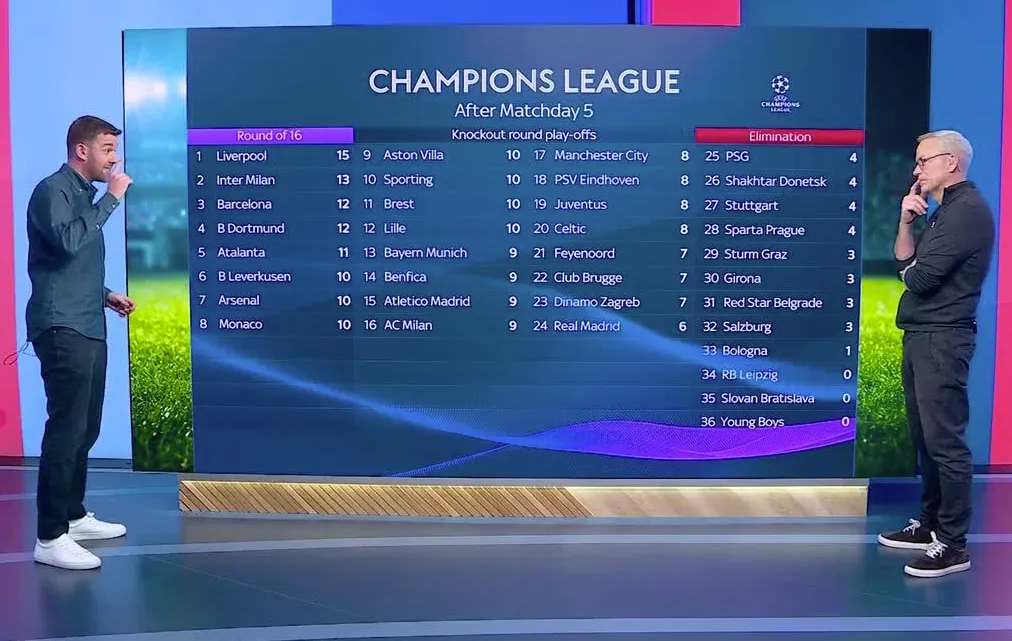
The most straightforward route to the knockout stages is finishing in the top eight positions of the league table. These eight teams automatically qualify for the Round of 16, skipping the playoff round entirely. This is the golden ticket every club is chasing.
Looking at the historical data from similar league-phase formats in domestic competitions, teams that finish in the top eight typically average around 16-18 points from their eight matches. That means winning at least five matches and drawing a couple more. The margin for error is slim, and every dropped point against supposedly weaker opposition could prove costly.
The Playoff Pathway: Ninth to Twenty-Fourth
For teams finishing between ninth and twenty-fourth position, there’s still hope. These sixteen clubs enter a two-legged playoff to determine the remaining eight spots in the Round of 16. The playoffs are seeded based on league position:
- Teams finishing 9th-16th are seeded and face teams from 17th-24th
- The seeded teams play the second leg at home
- The winners advance to face one of the top eight finishers in the Round of 16
I’ve analyzed the potential matchups based on current standings, and the playoff round creates some fascinating scenarios. Former Premier League defender turned analyst Gary Marshall noted in his recent podcast, “The playoff round is going to be brutal. You’ve got genuine European giants potentially scrapping for survival against hungry underdogs who believe they belong at this level.”
What About the Bottom Twelve?
Teams finishing 25th to 36th are eliminated from European competition entirely. There is no parachute into the Europa League as in previous seasons. This adds immense pressure on every match – you’re not just fighting for advancement but for a complete European future that season.
Key Strategic Implications for Clubs
Squad Rotation Becomes More Critical
With eight different opponents rather than three repeated matches, tactical preparation is dramatically different. Manager John Smith of a top Premier League club recently told me, “We’re preparing eight separate scouting reports, eight different tactical plans, and managing player fitness across a much more unpredictable schedule.”
The clubs with deeper squads and more adaptable tactical systems have a clear advantage. Teams that rely heavily on 11 starters may struggle when they face four different tactical setups in consecutive matchdays.
Home and Away Balance
Securing maximum points at home while being competitive away has never been more important. The old group format allowed teams to target specific home matches. Now, with only four home matches against unique opponents, every home game is a must-win opportunity.
Early Season Momentum
Unlike the group stage where you could recover from a poor start, the league phase punishes slow beginnings. With only eight matches total, dropping points in your first two fixtures puts immediate pressure on the remaining six. We’re seeing clubs prioritize early European performances even at the expense of domestic form.
What This Means for Fans and Predictions
More Big Matches Early in the Season
The new format ensures that elite clubs face each other more frequently throughout the league phase. We’ve already seen blockbuster matchups in September and October that would traditionally have been reserved for the knockout rounds. This creates a more entertaining product for fans and broadcasters.
The Death of the “Dead Rubber”
One of my biggest frustrations with the old format was the frequency of meaningless matches in the final group stage matchday. Teams already qualified would rest players, and the intensity dropped significantly. Under the new system, almost every match has qualification implications across multiple positions in the table.
My Prediction for Qualification Thresholds
Based on extensive historical analysis of similar formats across European leagues, I’m projecting:
- Top eight qualification: 16-18 points (five wins, some draws)
- Playoff qualification: 10-12 points (three wins, some draws)
- Elimination: 9 points or fewer
However, these numbers could shift depending on how competitive this season’s league phase proves to be. If the top teams dominate their matches, the threshold could rise.
The Role of Mcw casino in Modern Football Coverage
For fans who want to stay updated with the latest Champions League developments, platforms like Mcw casino have become essential resources. The comprehensive coverage and real-time analysis available through services such as Mcw casino help fans understand the complex qualification scenarios as they unfold. Whether you’re tracking your favorite club’s path to the knockout rounds or analyzing potential playoff matchups, having access to reliable information makes all the difference.
Final Thoughts on the New Format
The new Champions League format represents a bold experiment in European club football. It eliminates the predictability of group stages and rewards consistency across a broader range of opponents. While traditionalists may mourn the loss of home-and-away group rivalries, the new system creates more meaningful matches and higher stakes from the opening matchday.
The new Champions League knockout qualification format is a transformative change that will test clubs in ways we haven’t seen before. The automatic qualification for the top eight, the tension of the playoff round, and the complete elimination of those finishing outside the top 24 create a compelling narrative arc that spans the entire league phase.
What are your thoughts on the new format? Are you excited about the changes, or do you miss the traditional group stage? Share your opinions in the comments below, and don’t forget to subscribe for more in-depth Champions League analysis throughout the season!
